
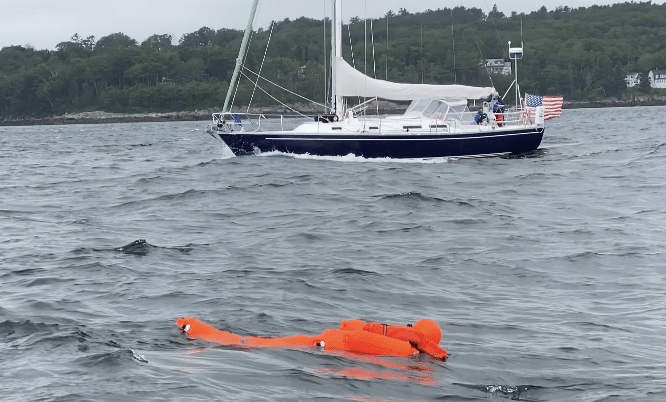
Adrenalin is coursing through every sailor’s veins this time of year as covers are removed and commissioning season begins. Every boatyard task seems to take longer than expected as fellow cruisers, some not seen in months, stop by for a chat and discussion of boat projects anticipated or completed and cruising plans for the summer. While the work list is long, the anticipation and expectations generate huge amounts of enthusiasm, but that needs to be tempered by the always-present risks of early-season cold water cruising in Maine.
A Cautionary Tale:
Some years ago I was bringing our boat, then a bright yellow San Juan 28 named Saffron, from the yard in early spring to our home port in York. While motoring past Kittery, we noticed an open 16’ sailing dinghy that had just capsized and filled with water. We quickly came alongside and offered assistance to the lone occupant who was soaking wet. Would he like to come aboard and we’d tow his boat to shore? The response was a gruff no, but he would like a bucket for bailing. Knowing the occupant had a reputation as occasionally tough minded and stubborn, his response seemed in character. We provided the bucket and I also tossed him my very warm jacket and we went on our way.
The next day I stopped by his shop to collect my jacket and bucket and was astonished when, instead of a thank you for providing assistance, he advised that he’d nearly died after we left. I protested that we had offered to take him aboard and get him to shore when he brought me up short. “Don’t you know that one of the first signs of hypothermia is the loss of cognitive ability? I damn near died!”
It was a lesson that I’ve never forgotten.
Sailing in early spring can be glorious, but with water temperatures in the 40s, it’s probably the most dangerous time of the year to be on the water.
As part of the CCA’s commitment to safety, Galen Todd, our safety officer, has authored a must-read advice column in the CCA Cruising Guide to Maine.
As a related safety initiative, before every race I give my crew a safety briefing.
Rule Number One is don’t fall overboard. Rule Number Two is to obey Rule Number One. Rule Number Three is obey Rule Number One.
Practice on Your Own Boat:
Galen has also been instrumental in the CCA’s latest safety initiative, Practice On Your Own Boat (POYOB). This initiative provides hands-on training that develops procedures specific to your boat to facilitate the recovery of a man overboard. The correct procedure is different from boat to boat and it’s essential that you know what works and doesn’t work on your boat.

Demonstration of MOB recovery proficiency has always been a requirement for participation in the Newport Bermuda Race, but now race organizers have adopted the CCA POYOB program as a structured training recommendation to satisfy that requirement. Having participated in POYOB, I can assure you that the reality of recovering a man overboard is a real eye-opener. Bermuda Race partnered with Landfall Navigation to help capture these eye-opening experiences. (Everyone who shares this Spring is entered to win a $200 gift card!)
Communications Updates:
One of the benefits of an online Cruising Guide is that it is continually updated. One more updated Advice column concerns Communications, VHF, and Cellular, while cruising in Maine.
Clearly, cellular is now a viable alternative to VHF when communicating with the Coast Guard. You should put this number in your phone’s contacts list 206-815-7220 (206 area code is NOT a typo) Try it. You will get a directory of options that includes USCG Sector Northern New England, as well as a variety of extensions at Station Rockland.
Visit for an update on all options for communications when cruising in Maine. https://guides.cruisingclub.org/tips-for-vhf-radio-vs-cell-phone/
Finally, as always we welcome feedback! We work very hard to keep the CCA Cruising Guide to Maine current and relevant to the cruising community. It’s a free service of the Cruising Club of America and we hope you enjoy it. Stay safe out there!