
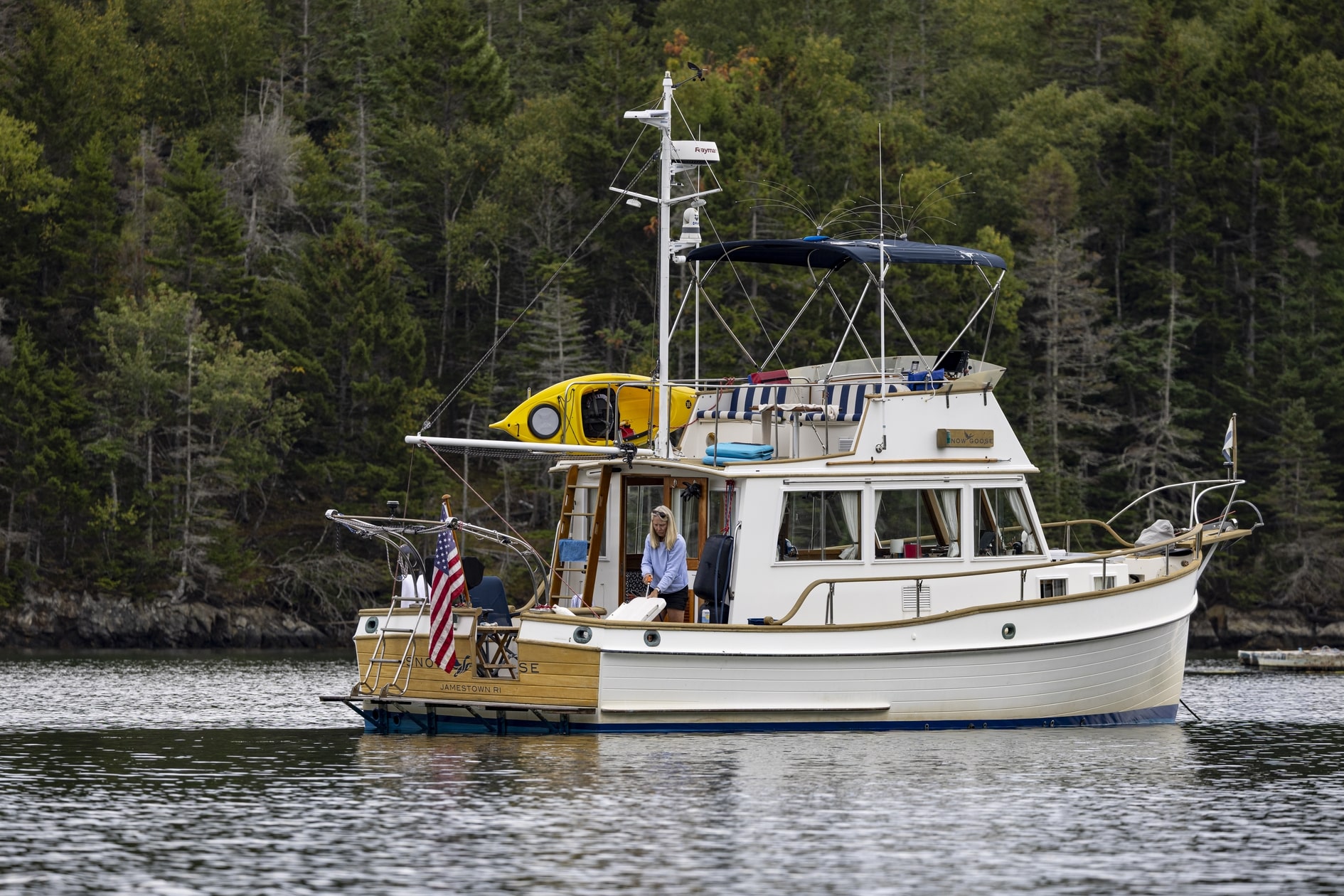
The Cruising Club of America member Onne van der Wal has been to the farthest reaches of the world in his nearly five decades as an award-winning marine photographer, but this past summer was his first-ever cruise of the Maine coast. Following is an excerpt from Onne’s observations and photos recently published in Soundings and Safe Harbor Water Magazine.
Having been to Maine many times over several years to photograph the new builds for Hinckley, Morris and Hodgdon yachts, I thought I knew Maine and couldn’t imagine it would be so different going on my own boat at my own pace, compared to shooting a yacht from a chase boat with a cast of clients, producers and models. Boy, was I wrong! I had never spent the night anchored in a deserted cove on my own boat, with not a soul to be seen or heard. Talk about peace and quiet—at times I thought I had gone deaf, as I couldn’t hear a thing! Sheer bliss.


Photos: Onne van der Wal
I had told several experienced boaters how I loved cruising in Southern New England from Block Island to Cuttyhunk and beyond on our Grand Banks 32 trawler Snow Goose and they all said “You ain’t seen nothing yet, go to Maine, you will fall in love with the cruising up there, and you’ll never want to cruise down here again;” well, they were right.
My wife Tenley and I had taken Snow Goose from our home port of Jamestown, RI down the ICW and on to the Bahamas in the winter of 2022/23 and took 6 months doing it. The Intra Coastal Waterway (ICW) was amazing, we loved exploring the waterway with all its quaint little towns, harbors, marshes and meandering rivers. We didn’t see the ICW as a highway to the South but a waterway to zig zag down to see and explore as many of its estuaries, marshes and villages as we could. We got excellent info from locals and other cruisers who really knew the ICW inside out and told us where to go. We just loved it and the time on board Snow Goose on our own schedule—if we loved a place we stayed; if not we moved on. We threw the calendar over the side and let the weather tell us when we could move on or we had to stay put. For me the most appealing part of the ICW was its natural beauty and the early American history of the areas we visited and passed through.
Maine had been on my bucket list since our ICW and Bahamas trip, but a few family weddings and other social engagements had kept us in Southern New England, so finally the summer of 2026 was going to be the summer we were going Down East and exploring Maine!


Photos: Onne van der Wal
I decided to give myself 6 days to get from Narragansett Bay to Rockland, Maine (a roughly 225 nm trip), weather permitting, and enjoy the ride up north and east with a variety of stops utilizing marinas, moorings and anchorages. Our first day was from Newport to the Safe Harbor Marina in Onset, MA, a perfect spot to hang out and wait for a fair tide in the Cape Cod Canal. The following day (after our super-fast canal transit) we shot across to Gloucester, leaving Boston well off to port with just the tallest buildings of the city visible above the horizon. The weather was perfect on all six legs, very little breeze and no swell or fog. The best stop of the trip up was the little cove at the island of Damariscove, which was stunning. We were the only ones there besides the caretaker and a lobsterman who swung by early in the morning to check his traps. The end point of our 6-day trip Down East was the Safe Harbor Marina in Rockland, which was also to be our base for our adventures into Penobscot Bay, and a mere 8 miles from Vinalhaven. It was a good place to get fuel, water and provisions. The marina has courtesy cars that sure makes shopping (and dinners in Camden with friends) possible.
Not having cruised Maine before we needed local knowledge and info for the hundreds of little coves, bays and islands, which seemed daunting. I had been told to buy the supposed “bible” for boating in Maine, the Taft Cruising Guide to the Maine Coast. They weren’t wrong—it’s a must have, just about every cove, anchorage and little town is mentioned in the book in detail from the approaches, to holding ground and places to visit ashore. But we also used the free online guide put together and continuously updated by the Cruising Club of America (CCA) called the Cruising Guide to Maine, which my wife Tenley felt was the best of all the guides we used. Local Mainers and good friends of ours, Tom and Jane Babbitt, CCA members, edit this guide, so we kept in touch with them, picking their brains for more locations and info that helped me find the perfect spots to photograph.


Photos: Onne van der Wal
Besides my Raymarine Axiom plotter I used the Aquamap nav app on my iPad, as they also have great local knowledge on their charts shown in the way of a little anchor icon that, when tapped, shows comments and reviews of boaters who had been there. It’s a wonderful tool for plotting the next day’s trip with waypoints, etc. Together, it was a good collection of local knowledge from the guides, our friends and fellow cruisers, without which we would have been lost.
Snow Goose, our GB 32, is the perfect little cruising boat for two people, but also the perfect photo boat. As my Maine photo buddy Peter Ralston calls his photo boat Raven his floating tripod, so it is with Snow Goose. She has a wide-open fly bridge, which is the best spot to drive from while entering tricky little bays and inlets but also gives you just that little bit of added height for a great camera perspective. What a luxury it is to explore, cruise and shoot from this little boat. It draws just over 3 feet, it uses a measly two gallons of diesel per hour at a steady 8 knots, and has all the creature comforts of a much larger boat. We have a 9-foot aluminum rigid inflatable in davits on the back of the boat, which the two of us use to explore and shoot the skinny coves or little towns to shop or eat ashore. I so enjoy entering a harbor or cove and finding the picture-perfect spot to anchor. I’ll pick the right spot to drop the hook to shoot the scene from with late light and or at sunrise. Many times I don’t even have to leave the boat; I may open one eye at sunrise, poke my head out of the forepeak hatch and see if it’s good enough to get to work with my camera. I call it sleeping on location! Never done that before in my pro shooting days. No excuses now—you never miss a good early morning or late afternoon scene again!


Photos: Onne van der Wal
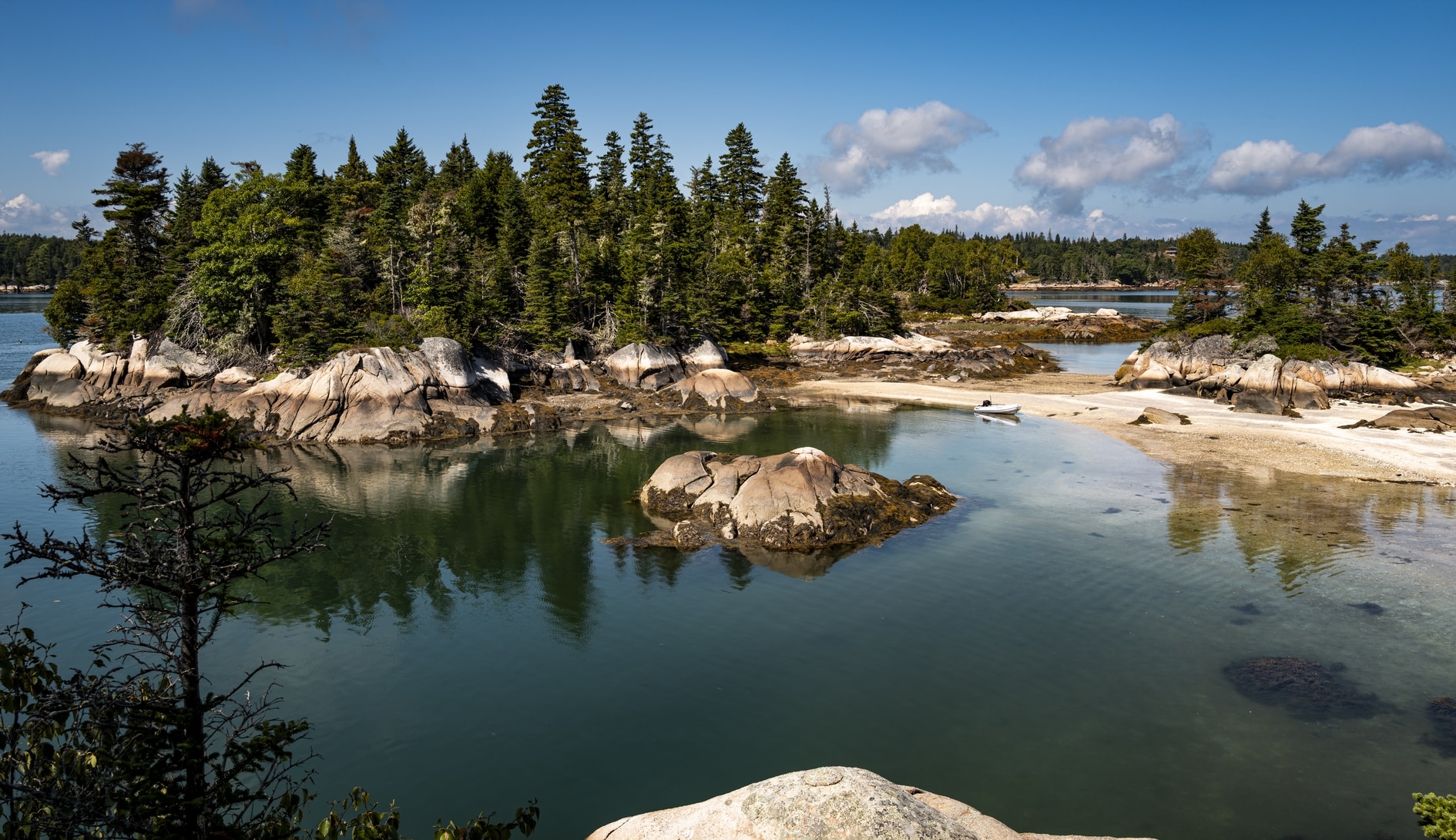
What a stunningly beautiful and easy area to cruise and explore. Penobscot Bay and its islands have such a special quality about them; yes, beautiful, but as I mentioned earlier so peaceful and of course picture perfect, which is one of the big reasons I wanted to come to Maine. We never experienced the crowded anchorages and towns one sees in Southern New England. In Maine the little coastal towns, villages and people have a certain genuineness, a great quality of life and lifestyle; it just comes across as a nice laid back and healthy way of living. I’ve become very attracted to life in Maine, especially coastal Maine.


Photos: Onne van der Wal
I loved boating, photographing and exploring the Maine coast, but I feel I have only scratched the surface. We hope to spend many more summers poking around the many bays, inlets, coves and harbors of Casco Bay, Penobscot bay, and parts Down East. Initially I was a little concerned about the 10 ft rise and fall of the tide, but if you remember what you draw and that the depth on the chart is at low water, you’re all good. My other concerns were the lobster pots and fishermen I had been warned about by fellow cruisers. There are some areas with lots of pots where you can forget about using the autopilot, as you are hand steering 99% of the time. It can seem like a never-ending slalom course, but I expected more pots and was pleasantly surprised at the lack of pots in most areas. If you keep a good watch, it’s very manageable. We gave the lobstermen lots of room—they cruise right along and seem to make very erratic unpredictable turns and speed changes, but you get used to their techniques.


Photos: Onne van der Wal
Since cell phone coverage can be spotty, I installed Starlink on Snow Goose this past winter as we need to keep in touch with our virtual gallery clients and my assignment clients. Without it we would have been off the grid some of the time, which for some is great but for us it would have been a problem. I have the Starlink Mini with an unlimited plan, and it worked like a gem. Another piece of great gear I added to the Goose are four Hamilton Ferris solar panels, giving me a total of 400 watts and plenty to keep the deep freeze, the Sea Frost refrigerator and ship’s batteries topped up; no need for generator noise and fumes first thing in the morning anymore.


Photos: Onne van der Wal
After almost two weeks of cruising Penobscot Bay, it was time to think about heading back to Rhode Island. We were sorry to leave but knew we would be back. I was already looking forward to new places to explore in Maine on the return journey. Instead of doing the return trip in a semi-hurried 6 days, we ended up doing it in 10 days. The highlight of the return trip was a day stop to hike, shoot and explore Seguin Island and its majestic lighthouse. There are guest moorings and a brand-new floating dock for your dink—well worth the slight detour.
What an amazing trip it was! I sure enjoyed poking around Penobscot Bay with my camera in hand to capture the beauty of the place. I hope my pictures have done the place justice.
We will be back!